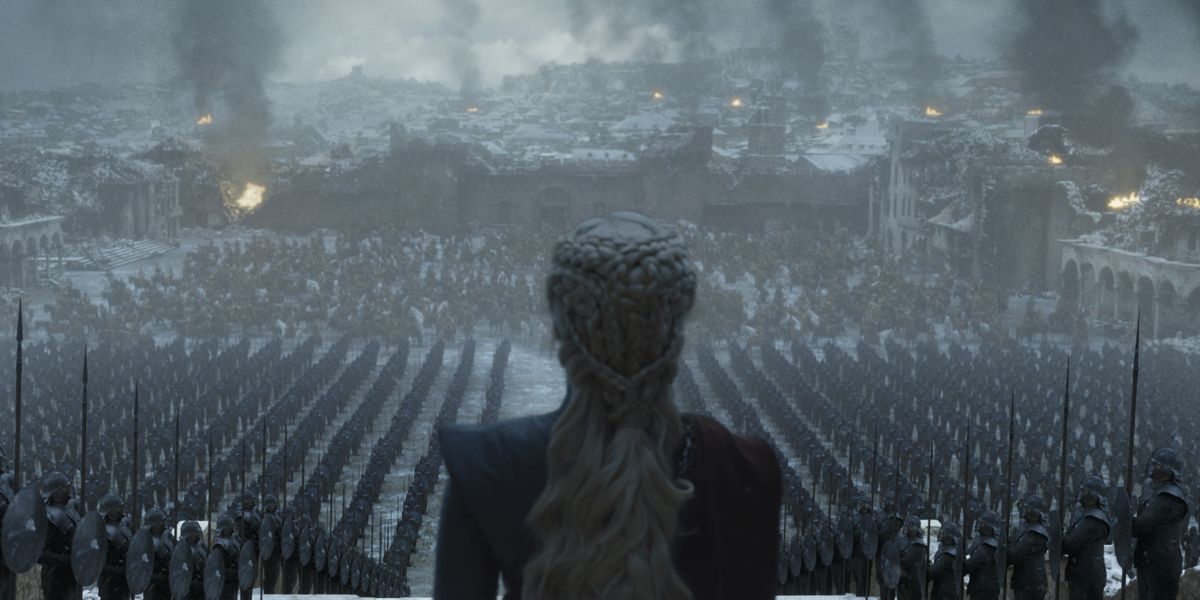
From the TV pilot to the Battle of the Bastards, take a deep dive into Westeros.
'Sport of Thrones'
We haven't had a TV present that moved tradition the best way Sport of Thrones did when it got here out. It was a behemoth that obtained everybody to take a seat down on Sunday nights to look at it reside.
There's quite a bit we are able to be taught from a present like that, however I needed to deal with the writing alone at the moment, by presenting a couple of episodes so that you can take a look at.
Let's dive in.
In terms of screenwriting classes, these are the issues I gleaned from studying all these episodes throughout seasons.
In The Godfather Half II (1974), Michael Corleone (Al Pacino) sits in quiet calculation, his phrases sharper than any blade:
“My father taught me many issues right here — he taught me on this room. He taught me: preserve your pals shut, however your enemies nearer.”
It’s a easy line, nevertheless it lands like a blueprint for survival. Inside the movie’s world of betrayal, shifting loyalties, and energy struggles, this single piece of recommendation turns into Michael’s guideline.
What’s fascinating is how a line written for against the law drama escaped the display and embedded itself within the language of technique. Over the many years, it has been quoted in boardrooms, warfare rooms, and even self-help books. Leaders, executives, and on a regular basis individuals have all invoked Michael’s chilly knowledge as if it had been a proverb.
However was it invented in 1974? Not fairly. The movie gave the concept its most memorable kind, however the roots stretch again to Solar Tzu, Machiavelli, and centuries of real-world energy politics.
That is the story of how Michael Corleone’s cinematic lesson grew to become the last word technique quote.
– YouTube www.youtube.com
The road arrives at a pivotal second in The Godfather Half II. Michael, already deep within the shadows of his father’s empire, understands that his biggest threats aren’t solely exterior rivals—they’re the individuals who sit at his personal desk. Within the context of the movie, it units the stage for Michael’s tactical maneuvering towards Hyman Roth (Lee Strasberg) and the betrayal inside his circle of relatives.
Francis Ford Coppola and screenwriter Mario Puzo designed the dialogue as a thesis for Michael’s entire character arc: energy maintained by means of watchfulness, proximity, and management.
What makes the road extraordinary is how seamlessly it migrated into real-world technique. All of the sudden, Michael’s phrases weren’t confined to mobsters and mafiosi; they had been being echoed by company executives managing rivals and politicians outmaneuvering rivals.
Its phrasing made an outdated concept digestible and sensible. In contrast to the dense language of Solar Tzu or Machiavelli, The Godfather Half II distilled the lesson into phrases anybody may recall and use. That’s the facility of cinema: turning a centuries-old precept right into a cultural catchphrase.
The underlying logic of Michael’s line has been round for millennia. Solar Tzu’s The Artwork of Struggle famously advises: “If you understand the enemy and know your self, you needn’t concern the results of 100 battles.”
The lesson is evident—victory comes from understanding your opponent as intimately as your self. Whereas not an identical in wording, the precept resonates with Michael’s recommendation: proximity breeds data, and data means leverage.
Quick ahead to Renaissance Italy, and Niccolò Machiavelli put ahead his personal tackle the identical precept. In The Prince, he argued that rulers should handle each allies and enemies by means of crafty, proximity, and manipulation.
Machiavelli emphasised appearances: controlling notion whereas quietly retaining adversaries inside attain. Michael’s line in The Godfather Half II mirrors this similar spirit of chilly pragmatism, dressed within the language of household loyalty.
Historical past is suffering from leaders who practiced this philosophy lengthy earlier than Michael Corleone made it well-known. Julius Caesar knew the risks of betrayal and famously saved his rivals shut till daggers proved in any other case. Otto von Bismarck used alliances with adversaries to take care of energy in a fractured Europe.
These figures remind us that Michael’s line goes past being only a Hollywood invention. It emerges as a restatement of how survival has at all times labored on the highest ranges of energy.
Within the company world, keeping track of your competitors is virtually doctrine. Corporations like Apple and Samsung continuously monitor one another, not simply to outdo, however to anticipate strikes. Executives usually construct partnerships with rivals for mutual profit, even whereas plotting to dominate them within the market.
That’s “pals shut, enemies nearer” in motion.
Politics runs on related logic. Diplomats usually host adversaries on the similar tables the place alliances are cast. Chilly Struggle historical past is filled with backchannel talks between rivals who smiled for images whereas spying on each other.
Even at the moment, worldwide relations depend on this delicate steadiness—shaking fingers with enemies whereas learning their each transfer.
Past boardrooms and politics, the technique works at a human stage too. Conserving adversaries shut reduces unpredictability. It enables you to handle the risk as a substitute of being blindsided by it.
Psychologists argue that proximity breeds each belief and management—two levers that may disarm even the sharpest opponent. Michael Corleone could have been ruthless, however his logic nonetheless applies in on a regular basis conflicts, whether or not at work or in social circles.
In fact, there’s a flip facet. Conserving enemies nearer may blur into paranoia. Michael Corleone embodies this downfall. His obsession with management isolates him, erodes his relationships, and traps him in a cycle of mistrust.
Vigilance turns into suffocating when it crosses into obsession—a warning as a lot as a technique.
Then comes the moral dilemma. Is it manipulative by default? Can it ever be a clear technique? Whereas Machiavelli would possibly shrug, trendy leaders need to wrestle with how far is just too far.
Utilizing this strategy ethically means balancing warning with equity—as a result of treating everybody like an enemy dangers destroying belief even with precise pals.
 Al Pacino as Michael Corleone in 'The Godfather'Credit score: Paramount Photos
The road endures as a result of it’s sensible—however solely when utilized with care. Realizing your adversaries, staying alert to rivals, and anticipating challenges is invaluable in management, negotiation, and even inventive work.
However proximity shouldn’t come at the price of integrity or sanity. The true trick is figuring out when the technique serves you and when it traps you. Used correctly, it sharpens consciousness; abused, it corrodes belief and stability.
Michael Corleone’s line in The Godfather Half II could not have invented the idea, nevertheless it perfected its phrasing. From Solar Tzu’s battlefields to Machiavelli’s courts to trendy boardrooms, the concept of retaining enemies inside attain has at all times been about management, foresight, and survival.
What Coppola and Puzo did was give the world a phrase so concise that it may reside past the movie—half warning, half weapon. The brilliance of the quote lies in its duality: it’s each knowledge and cynicism, relying on how you utilize it.
And perhaps that’s the ultimate lesson—technique, like energy, isn’t simply in regards to the transfer you make, however the price you’re keen to pay for it.

Step Inside Westeros: The 'Sport of Thrones' Scripts You Can Learn At the moment – No Movie College


Get latest Gaming News on Pley2win.com. Popular Games, New released, Gaming Review, Xbox gaming, PlayStation, PC, Mobile Gaming and More!!